ABB Launches Next Generation Cobots to Unlock Automation for New Sectors and First-Time Users
March 10, 2021
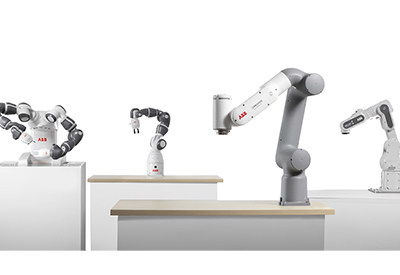
ABB is expanding its collaborative robot (cobot) portfolio with the new GoFa and SWIFTI cobot families, offering higher payloads and speeds, to complement YuMi and Single Arm YuMi in ABB’s cobot line-up. These stronger, faster and more capable cobots will accelerate the company’s expansion in high-growth segments including electronics, healthcare, consumer goods, logistics and food and beverage, amongst others, meeting the growing demand for automation across multiple industries.
GoFa and SWIFTI are intuitively designed so customers need not rely on in-house programming specialists. This will unlock industries that have low levels of automation, with customers able to operate their cobot within minutes of installation, straight out of the box, with no specialized training.
“Our new cobot portfolio is the most diverse on the market, offering the potential to transform workplaces and help our customers achieve new levels of operational performance and growth”, said Sami Atiya, President of ABB’s Robotics & Discrete Automation Business Area. “They are easy to use and configure and backed by our global network of on-call, on-line service experts to ensure that businesses of all sizes and new sectors of the economy, far beyond manufacturing, can embrace robots for the first time.”
ABB’s cobot portfolio expansion is engineered to help existing and new robot users accelerate automation amid four key megatrends including individualized consumers, labor shortages, digitalization and uncertainty that are transforming business and driving automation into new sectors of the economy. The expansion follows the Business Area’s focus on high-growth segments through portfolio innovation, helping to drive profitable growth.
{videobox}sAUVaOxcPuM{/videobox}
Automation driving the future of manufacturing
In a global survey of 1650 large and small businesses in Europe, the US and China, 84 percent of businesses said they will introduce or increase the use of robotics and automation in the next decade, while 85 per cent said the pandemic had been “game changing” for their business and industry, with COVID-19 a catalyst for accelerating investment in automation. Nearly half of businesses (43 percent) said they were looking to robotics to help them improve workplace health and safety, 51 percent said robotics could enhance social distancing and more than one-third (36 percent) were considering using robotic automation to improve the quality of work for their employees. More immediately, 78 percent of company CEOs and Managing Directors said recruiting and retaining staff for repetitive and ergonomically challenging jobs is a challenge.
Cobots are designed to operate in the presence of workers without the need for physical safety measures such as fences and to be very easy to use and install. In 2019, more than 22,000 new collaborative robots were deployed globally, up 19 percent compared to the previous year. The demand for collaborative robots is estimated to grow at a CAGR of 17 percent between 2020 and 2025 while the value of global cobot sales is expected to increase from an estimated $ ~0.7 billion in 2019 to $ ~1.4 bn by 2025. The global market for all industrial robots is projected to grow from $ ~45 billion in 2020 to $ ~58 billion by 2023 (CAGR of 9 percent).
GoFa and SWIFTI are engineered to help businesses automate processes to assist workers with tasks including material handling, machine tending, component assembly and packaging in manufacturing, medical laboratories, logistics hubs and warehouses, workshops, and small production facilities.
“With this expansion, we are making cobots easier to use and deploy, with real-time support to help speed their adoption in businesses that may have not considered their use previously,” Atiya said. “Our experience is that the best performing operations harness people’s skills, alongside the potential of new technologies.”
Users comfortable with operating a tablet or smartphone will be able to program and re-program the new cobots with ease, using ABB’s fast set-up tools. Customers will also benefit from ABB’s global industry and application expertise, which has been developed from installing more than 500,000 robot solutions since 1974 and supported by ABB’s network of over 1,000 global partners.
The new GoFa and SWIFTI cobot families build on the success of ABB’s YuMi family, which has been helping businesses safely automate key tasks since YuMi, the world’s first truly collaborative robot, was launched in 2015. Today, ABB’s YuMi cobots are working alongside people in factories, workshops and laboratories all over the world, performing tasks from screwdriving and assembling electronics and electrical components, to making valves and USB sticks, and testing COVID-19 samples in laboratories.
Every ABB cobot installation includes a start-up package that provides ABB Ability condition monitoring & diagnostics as well as a support hotline free for the first six months to access ABB’s expert technical assistance, which is offering support across all industry segments.