|

New System Release 1.24 – PILZ’s PSS 4000

February 24, 2023
New System Release 1.24 – PILZ’s PSS 4000
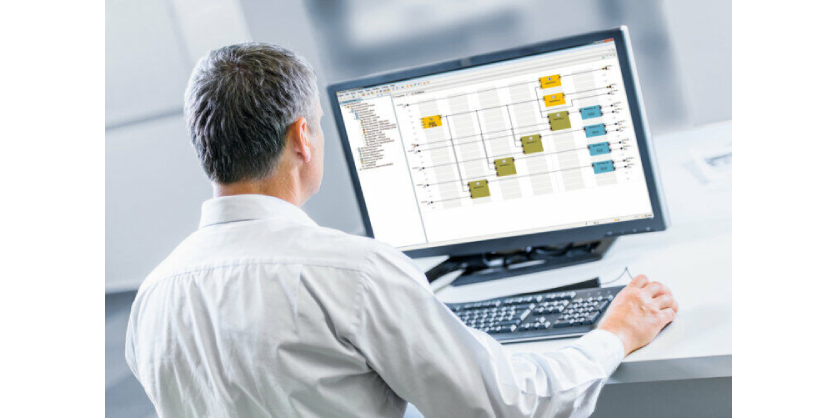
New functions are available for the automation system PSS 4000 with system release 1.24. Information about the most important ones is available here in the overview

New data types FIXED and LFIXED

The data types FIXED (fixed point number with 6 decimal places) and LFIXED (fixed point number with 11 decimal places) are now available for the controller PSSu H PLC2 FS SN SD(-T). As a result, more complex arithmetic calculations are now possible.

Nesting of data types up to a depth of 16

The declaration of data types in the user program is now possible with a nesting depth of up to 16. Each dimension of an array variable (ARRAY) is also added to the nesting depth. That enables you to structure the project better.

Increased security through the function “Link device projects to devices”

Previously, devices with a device key have also executed projects that had no project key. Now, with system release 1.24, it can be configured that a device with a device key only executes projects with the appropriate project key. This guarantees that only projects that are actually assigned to the device can be executed on the device.

Support of Windows 11

The use of PAS4000 under Windows 11 is now supported.

Software to download New System Release 1.24 can be found here:

Software Download

Related Story

Access Management for Your Plant and Machinery

With PILZ’s “Identification and Access Management” portfolio, they offer you a comprehensive range of products, solutions and software for the implementation of safety as well as security tasks. Below you’ll discover more about potential applications, from simple authentication to complex access permissions, and access management through to safe operating mode selection, maintenance safeguarding and safeguarding of data and networks. Experience safety and security in one system!
Related Articles


Latest Articles

  • What Is Regenerative Braking?

    December 9, 2025 Regenerative braking is a system that converts kinetic energy – normally lost as heat during braking – into electrical energy that can be stored or reused. Instead of using friction brakes to dissipate energy, the motor functions as a generator during deceleration, reversing the flow of current. The rotational energy from the… Read More…

  • Cyber Resilience Act: Insights from Pilz

    December 4, 2025 The Cyber Resilience Act brings with it a host of new requirements. Which requirements will apply in future? From 11 December 2027, only products that comply with the requirements of the Cyber Resilience Act (CRA) may be placed on the market within the European Union. The CRA contains requirements for the cybersecurity of… Read More…


Featured Article

Revolutionizing Material Movement with Autonomous Mobile Robots

Revolutionizing Material Movement with Autonomous Mobile Robots

In today’s fast-paced manufacturing and logistics industries, the need for efficient and flexible material movement solutions has never been greater. Traditional methods like conveyor systems, forklifts, and manual pushcarts have served us well, but they come with limitations.

That’s why Omron is thrilled to announce the launch of their game-changing MD Series of Autonomous Mobile Robots (AMRs). Read more


Products

  • Schneider Electric Debuts One Digital Grid Platform to Help Utilities Modernize and Address Energy Costs

    December 12, 2025 Schneider Electric, a global energy technology leader, announced the availability of its One Digital Grid Platform, a unified, artificial intelligence AI-enabled software platform designed to help utilities modernize faster, strengthen grid resilience and reduce energy costs. The platform was launched simultaneously in Spain at Enlit Europe, attended by more than 15,000 professionals from… Read More…

  • A One-Stop Shop: Pilz Machine Acceptance Service

    December 10, 2025 Design Risk Assessment, Factory Acceptance Test and Site Acceptance Test Key phases of the design, manufacture and supply of plant and machinery are based on different legal and normative requirements. For this reason, it is important that all legal requirements are met at these points, before the plant/machinery is transferred to the next phase. The legal provisions vary from country… Read More…