New Surge Protection for Photovoltaic Applications
August 15, 2024
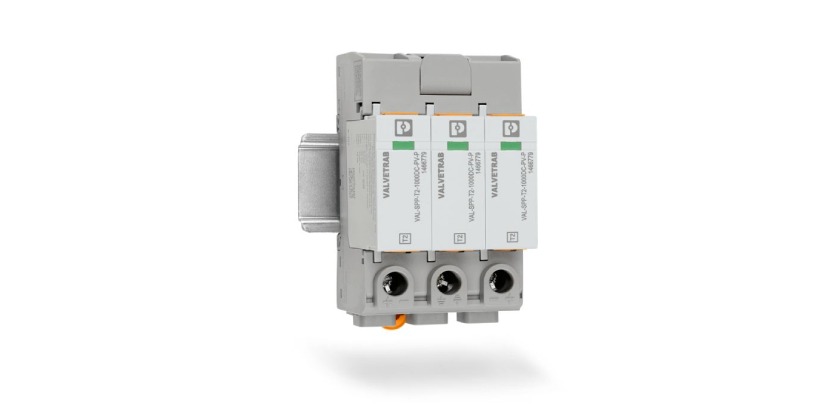
The new surge protective devices in the VALVETRAB SPP product family from Phoenix Contact offer forward-thinking installation and safety features. They are therefore also suitable for PV applications.
The new disconnection feature responds even more quickly in the event of an overload, which provides additional safety. The main and auxiliary circuits are now fitted with double insulation. The air clearances and creepage distances are achieved by extended screw shafts and insertion funnels on the product. This measure also provides touch protection. A major installation advantage is the reduced tightening torque of just 3 Nm instead of 4.5 Nm. In addition, the status display on the individual protective plugs has been optimized. Here, a clear red-green display makes it possible to read the plug status on site.
The PV products in the VALVETRAB SPP product family are available as pure type 2 surge protective devices for various voltage levels from 600 to 1,500 V DC. In addition, a type 1 lightning current arrester for 1,000 V DC is also available. The surge protective devices are available with and without remote indication contact.
More Information
Related Story
PCB Terminal Block for Single Pair Ethernet from Phoenix Contact
The networking of smart devices continues to advance. This applies in particular to sensors that are often exposed to higher-altitude ambient conditions when used in the field. In addition to the possibility of integrating an IP-protected connector into such field devices, there is also the option of using a cable gland to achieve the desired degree of protection. This means that the PCB terminal blocks, tested and suitable for SPE data transmission, can be used inside the devices.