How the OS33C Safety Scanner is Making Workplaces Safer and More Efficient
June 19, 2024
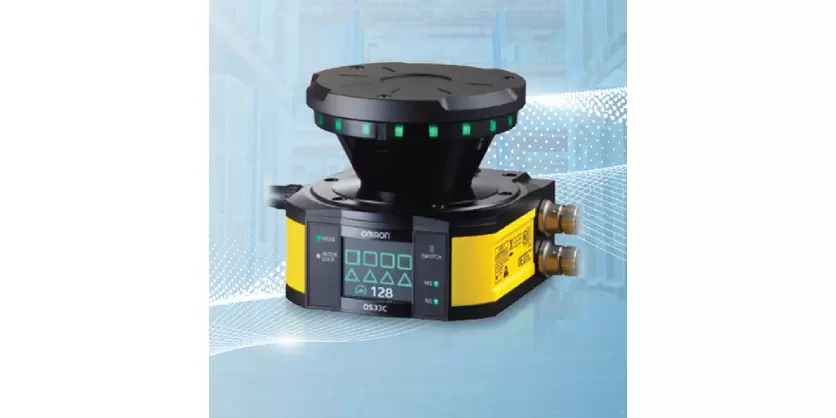
In today’s fast-paced and demanding industrial environments, ensuring workplace safety and operational efficiency is paramount. However, customers often face a range of challenges that hinder their productivity and increase costs. Enter the OS33C Safety Scanner, a revolutionary solution that addresses these issues head-on, making workplaces safer and more efficient than ever before.
In this blog, Omron discusses the main challenges faced by customers in mobile and fixed applications, and how the OS33C Safety Scanner effectively solves these challenges, making workplaces safer and more efficient.
Problem 1: High Costs and Downtime in Mobile Applications
The high cost of autonomous mobile robots (AMRs) and frequent downtime caused by scanner issues pose significant challenges. Complex maintenance requirements and labor shortages further hinder efficient operation.
The OS33C Safety Scanner comes equipped with built-in troubleshooting and diagnostic tools, allowing for minimal downtime and easy maintenance. This reduces costs, enhances operational efficiency, and improves safety in demanding environments.
Problem 2: False Trips and Complex Maintenance in Fixed Applications
Customers in fixed applications struggle with false trips caused by environmental factors, safety device bypass attempts, and time-consuming sensor and equipment wiring. The troubleshooting process requiring specialized software and equipment adds to their challenges.
The OS33C Safety Scanner offers improved detection capability and environmental resistance, enabling precise navigation and reducing false trips. It also streamlines equipment wiring, minimizing complexity and maintenance requirements. This ensures safe and efficient operation, enhancing productivity and reducing maintenance costs.
Problem 3: Communication Protocol Challenges in Mobile and Fixed Applications
Customers face challenges with different communication protocols and devices, leading to integration difficulties and potential safety risks.
The OS33C Safety Scanner offers CIP Safety Communication, an open networking protocol compatible with various devices and controllers. This simplifies integration, enhances safety, and allows for flexible network topologies. It enables efficient wiring setups, certification for communication with ODVA CIP safety controllers, and streamlined integration. This feature reduces complexity, enhances safety, and ensures seamless communication.
Problem 4: Limited Space and Fragility in Mobile and Fixed Applications
Customers in both mobile and fixed applications struggle with limited space for safety devices and the fragility of larger scanners, leading to downtime and replacements.
The OS33C Safety Scanner offers a compact design with a 42% reduction in size compared to its predecessor. It fits in space-constrained applications and is designed to withstand normal operations, reducing the risk of damage and minimizing downtime. This compact and durable solution enhances operational efficiency, reduces downtime, and minimizes the need for replacements, improving productivity and cost-effectiveness.
In conclusion, the OS33C Safety Scanner revolutionizes workplace safety and operational efficiency. It addresses challenges in both mobile and fixed applications, reducing downtime, simplifying maintenance, enhancing navigation performance, and providing flexible safety solutions. With the OS33C Safety Scanner, workplaces become safer, more efficient, and more productive, leading to improved business outcomes.
More Information
Learn more about the OS33C Safety Laser Scanner
Related Story
Improving Industrial Sensing: Omron’s Smart Fiber Sensor
Omron, a leader in industrial automation, has recently unveiled its latest Fiber Optic Amplifier which addresses critical market problems, and improves the way industrial sensing is approached. This blog post will delve into the big picture impact of this product release, focusing on the solutions it offers and the effects it can have on various industries.