Siemens’ Climate-Neutral Campus in Zug Highlights Investment In Excellence and Switzerland
September 11, 2023
- Investment of CHF250 million creates climate neutral campus for 1,700 colleagues
- State-of-the-art sustainability flagship built by combining real and digital worlds
- Inauguration of R&D facility marks final addition to the Siemens Campus in Zug
- Siemens Smart Infrastructure business aims to advance technology for a greener future
Inauguration of R&D facility marks final addition to the Siemens Campus in Zug
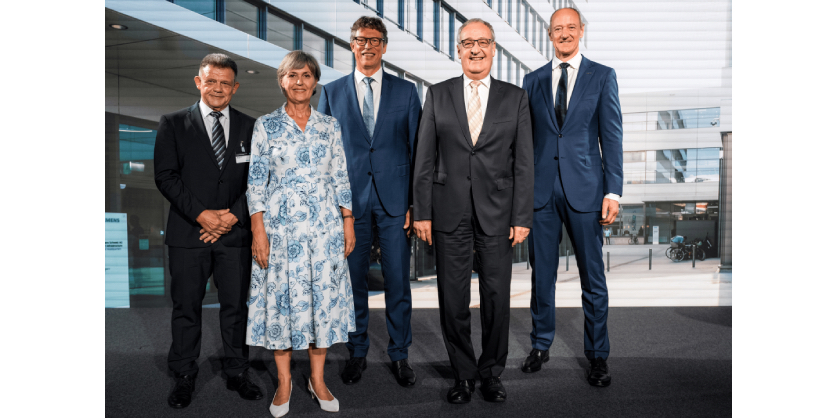
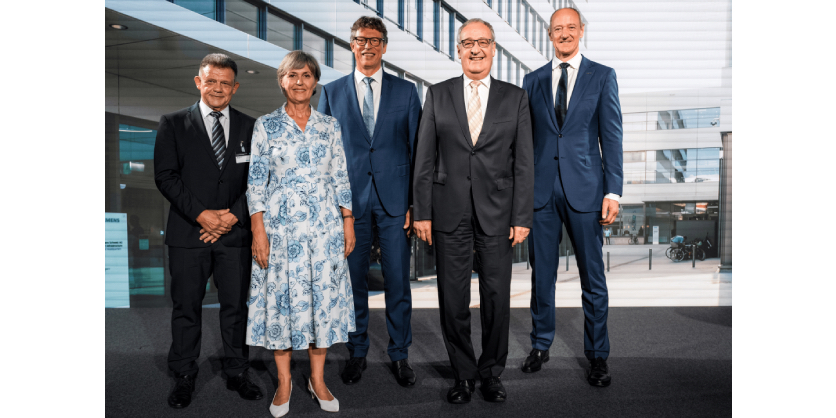
Siemens has inaugurated a new Research and Development (R&D) facility in the presence of Swiss Economy Minister Guy Parmelin, Canton Zug Government Councilor Silvia Thalmann-Gut and Roland Busch, the President and CEO of Siemens AG, to mark the completion of its CHF250 million investment and the seven-year construction of its climate-neutral campus in Zug, Switzerland.
“Technology is the key to sustainability,” said Roland Busch. “With 40 percent of global energy demand coming from buildings, zero carbon facilities are a huge lever for businesses – and countries – to become greener. It’s complex. We use artificial intelligence to orchestrate hardware and software. Switzerland’s high environmental standards and world class universities make it the perfect place to advance this technology. And Siemens Xcelerator, our new digital business platform, makes it easier for customers to implement by making it modular.”
Roland Busch, President and CEO of Siemens AG
“Siemens uniquely combines the real and the digital worlds to create a better tomorrow. The new Siemens Campus in Zug is a great example of this,” said Matthias Rebellius, member of the managing board of Siemens AG and CEO of Smart Infrastructure. “Featuring the latest technology from across our portfolio to enhance building operations and achieve the highest efficiencies, the campus will operate in a completely climate-neutral way, reaching the target we committed to two years ago.”
Matthias Rebellius, member of the managing board of Siemens AG and CEO of Smart Infrastructure
As the global HQ for Smart Infrastructure, Zug is a key location for the development of building technologies, filing around 80 new patents every year. The 25,000 square meter-campus consists of a main building, a factory and the newly-added R&D Center. Climate neutrality is achieved through a combination of different measures.
Heat pumps and water from Lake Zug are used for cooling and heating, while rooftop photovoltaic systems produce electricity. Planted flat roofs provide an additional layer of insulation. Siemens’ building automation system Desigo CC, part of Siemens Xcelerator, provides optimal room climate control as well as energy efficiency, and together with LED lighting, the system ensures the best possible indoor comfort. In addition, over 50 Siemens-owned charging stations support sustainable mobility. The office building has achieved platinum certification according to the LEED standard, while the production facility and R&D building both achieve gold standards.
Building Information Modeling (BIM) was used in the design of the campus. With BIM, a building is constructed twice: First virtually, then in the real world. It allows electricity, heating, cooling and water consumption to be documented, measured and adjusted through various applications. A room reservation system is connected to Siport access control and Desigo CC for demand-driven room control and digital signage. In addition, a wide variety of IoT functions have already been implemented to increase building efficiency, improve comfort and optimize user experience.
The attendees of the opening will have the opportunity to see Building X, Siemens’ scalable digital building platform, in action during their tour of the campus. Also part of the Siemens Xcelerator portfolio, Building X helps customers digitalize, manage, and optimize building operations, allowing for enhanced user experience, increased performance, and improved sustainability.
The R&D building, modernized at a cost of around 70 million Swiss francs, is the latest chapter in a long tradition of Siemens investments in Switzerland. More than 70 years ago, Siemens was already working closely with the then fire alarm company Cerberus. In 1998, Siemens took over the industrial activities of Elektrowatt, which in addition to Cerberus also included the Zug-based company Landis & Gyr, and from this formed the Building Technologies business unit. Since then, the Siemens Building Technologies division became part of Siemens Smart Infrastructure in 2019, making an important contribution to value creation in the region and throughout Switzerland.
The campus is now complete, providing a climate-neutral working environment for more than 1,700 colleagues to advance the technological development for critical infrastructure worldwide.
Related Story
Siemens Launches Siemens Xcelerator in Canada
To unlock the value of digitalization at speed and scale for its Canadian customers, Siemens has launched its global open digital business platform, Siemens Xcelerator, in Toronto at Collision Conference 2023. The platform accelerates digital transformation and value creation for customers of all sizes in industry, buildings, grids and mobility and includes an evolving marketplace to facilitate interactions and transactions between customers, partners and developers.